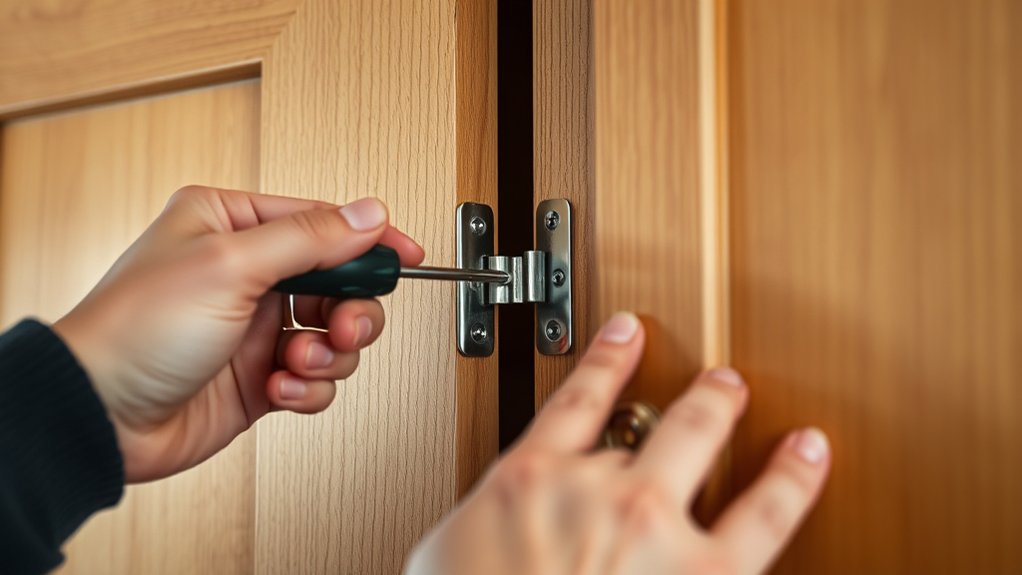
How Do You Adjust Kitchen Cupboard Hinges
Adjusting kitchen cupboard hinges might seem simple, yet even a slight misalignment can disrupt your entire cabinet system. Kitchen cupboard hinges need careful attention because uneven doors, varying gaps, or doors that don’t close properly can affect both function and appearance.
Before making any adjustments, identify these issues clearly. Understanding which screws control height, depth, or side-to-side movement is essential to restore smooth operation.
Let’s explore the exact steps and tools you’ll use to achieve consistent, professional results.
How to Identify When Kitchen Cupboard Hinges Need Adjusting
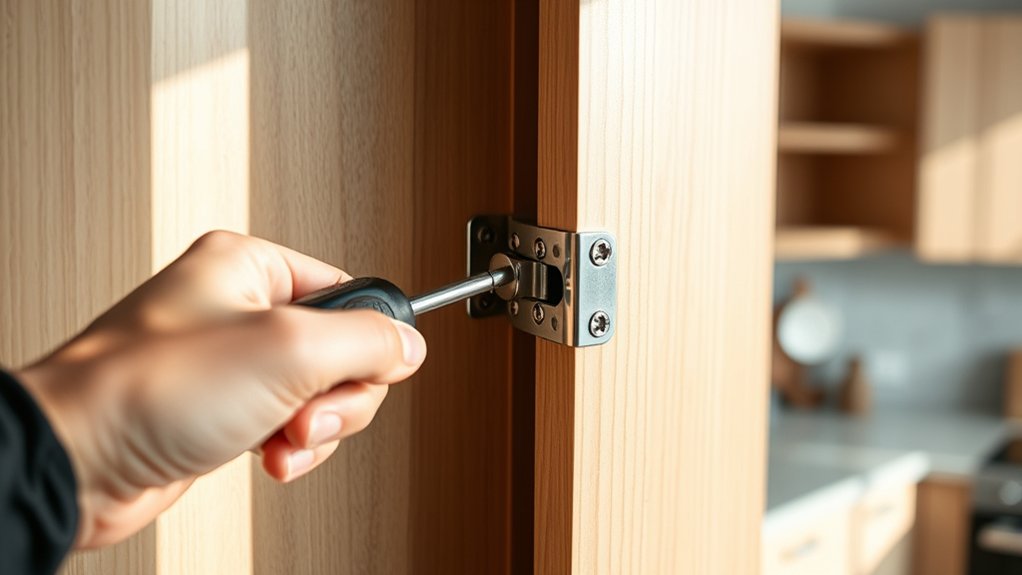
Misaligned doors, uneven gaps, and difficulty closing are clear signs that your kitchen cupboard hinges need adjusting. Start by visually inspecting the doors for consistent spacing between them and the frame; uneven gaps indicate misalignment.
Misaligned doors and uneven gaps are sure signs your kitchen cupboard hinges need adjustment.
Next, check if doors sit flush when closed. Any protrusion suggests adjustment is necessary. Physically test the doors by opening and closing them; if they stick or don’t move smoothly, hinge wear might be causing the issue.
Listen for unusual sounds like creaking, which also signal hinge problems. Use a flashlight to examine the hinge mechanism for rust, looseness, or damage, which directly affect door alignment.
Identifying misalignment early prevents further wear and damage to both hinges and cupboard doors. By systematically assessing door position, operation, and hinge condition, you can accurately determine when adjustment is required, ensuring your kitchen cupboards function properly and maintain their appearance.
How to Choose Tools for Adjusting Kitchen Cupboard Hinges
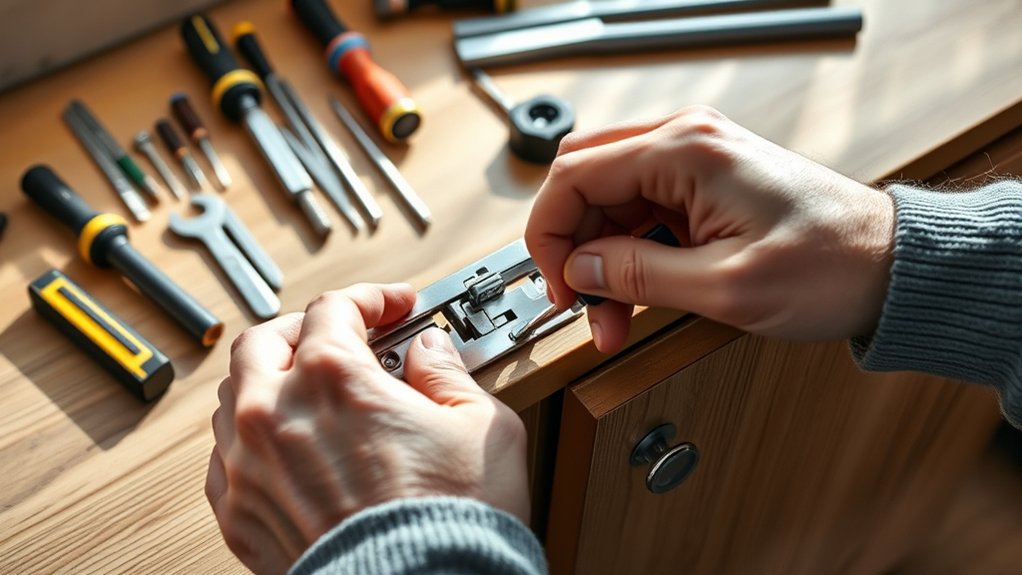
Choosing the right toolkit is essential when adjusting kitchen cupboard hinges to guarantee efficiency and accuracy. Start by reviewing an adjustments overview to understand the specific movements, vertical, horizontal, and depth, you’ll need to make.
Your tool selection hinges on the type of hinge; standard European hinges typically require a Phillips screwdriver, while specialty hinges may need an Allen key or a flathead screwdriver.
Ensure your screwdrivers have magnetic tips to prevent dropped screws and opt for precision screwdrivers for tighter spaces. A good-quality tape measure or ruler can assist in measuring gaps and alignment during adjustments.
Additionally, a spirit level helps verify the door’s horizontal position after adjustments.
How to Adjust Different Types of Kitchen Cupboard Hinges
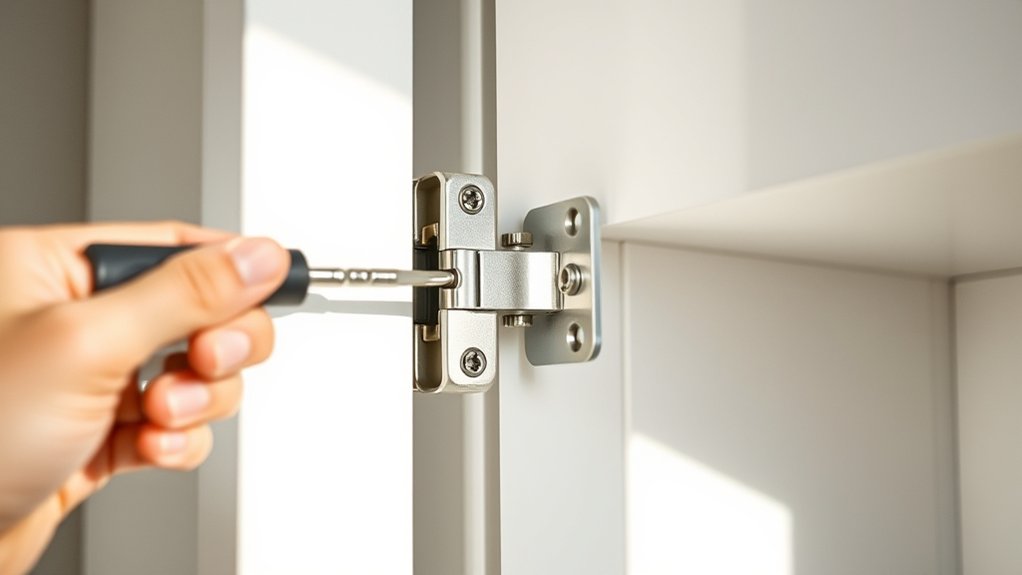
How exactly do you adjust various types of kitchen cupboard hinges to achieve perfect alignment? Start by identifying the hinge type. Concealed, surface-mounted, or specialty hinges each require specific adjustments.
For concealed hinges, use a screwdriver to turn the screws near the hinge arm to adjust the door laterally or vertically. Surface-mounted hinges typically have screws on the mounting plate; loosening these allows you to reposition the door before tightening.
Specialty hinges, like inset or pivot types, often have dedicated screws or cams for fine-tuning. When adjusting, apply small incremental turns and test the door fit frequently.
Always consult topic ideas on hinge maintenance to understand screw functions and avoid stripping. Proper hinge maintenance includes cleaning moving parts and lubricating pivot points.
This technical approach ensures you correct misalignments precisely without damaging the hardware or cupboard. Following these steps helps you maintain smooth operation and a professional finish in your kitchen cabinetry.
How to Adjust the Depth of Kitchen Cupboard Hinges
Begin by locating the depth adjustment screw on your kitchen cupboard hinge, typically found on the hinge arm or mounting plate. This screw controls how close or far the door sits from the cabinet frame.
Understanding adjustment basics is essential before proceeding, as different hinge types, such as concealed or overlay hinges, may require specific tools or techniques.
To adjust depth, use a screwdriver to turn the depth screw clockwise to move the door closer or counterclockwise to move it away. Make small incremental turns and check door alignment frequently to avoid over-adjustment.
| Hinge Type | Depth Adjustment Location | Effect of Turning Screw | Recommended Tool |
|---|---|---|---|
| Concealed Hinge | Hinge arm | Moves door in/out | Phillips screwdriver |
| Overlay Hinge | Mounting plate | Moves door in/out | Flathead screwdriver |
| Full Wrap Hinge | Hinge arm | Moves door in/out | Phillips screwdriver |
| Partial Wrap Hinge | Mounting plate | Moves door in/out | Flathead screwdriver |
Mastering these steps ensures precise depth alignment.
Fix Side-to-Side Misaligned Cupboard Doors
First, identify what’s causing the side-to-side misalignment by inspecting the hinge placement and door fit. Then, loosen the hinge screws slightly to allow movement.
Finally, adjust the door position horizontally until it aligns properly, and tighten the screws to secure it.
Identify Misalignment Cause
Why are your cupboard doors not sitting flush side-to-side? Misalignment causes often stem from hinge wear or installation issues. To identify the exact cause, follow these steps:
- Inspect hinges for visible wear, rust, or damage that could shift door positioning.
- Check if the mounting plates or screws have loosened, causing hinge misalignment.
- Examine the door edges for warping or swelling that affects side-to-side alignment.
- Verify the cabinet frame is square and hasn’t shifted or settled over time.
Loosen Hinge Screws
How should you approach loosening hinge screws to correct side-to-side misalignment? Start by locating the screws securing the hinge to both the cupboard door and the cabinet frame. Use a suitable screwdriver to slightly loosen these screws. Never remove them completely.
Loosening the screws eases tension, allowing you to shift the door horizontally. Be cautious with loose screws, as they can worsen hinge alignment or cause instability. Once loosened, gently move the door side-to-side to align it properly with adjacent doors or the cabinet frame.
After achieving the desired position, retighten the screws firmly to secure the hinge in place. This controlled loosening and retightening process is essential for precise hinge alignment and ensures smooth door operation without gaps or overlaps.
Adjust Door Position
Where exactly should you move the cupboard door to correct side-to-side misalignment? Focus on shifting the door horizontally to align the door gap evenly. Here’s how to precisely adjust the door position:
- Slightly loosen the hinge screws without fully removing them.
- Gently push or pull the door sideways to reduce the door gap or align it with adjacent doors.
- Tighten the screws while holding the door in the adjusted position.
- Open and close the door to check for smooth operation and consistent gap.
If the misalignment persists after adjustment, consider hinge replacement. Selecting quality hinges ensures stable door positioning and prevents recurring misalignment. Adjusting the door position carefully corrects side-to-side issues, improving overall cupboard functionality and appearance.
How to Adjust the Height of Kitchen Cupboard Doors
Start by locating the height adjustment screws on your cupboard hinges, usually found near the mounting plate. Use a screwdriver to turn these screws, raising or lowering the door to the desired position.
After each adjustment, test the door’s alignment to ensure it sits evenly with adjacent doors.
Locate Height Adjustment Screws
Finding the height adjustment screws is essential for aligning your kitchen cupboard doors correctly. These screws control the vertical position, allowing precise adjusting height for a perfect fit.
To locate them:
- Open the cupboard door fully to expose the hinge mechanism.
- Identify the main hinge arm attached to the door and the mounting plate fixed to the cabinet frame.
- Find the small screws on the hinge arm; these are typically the height adjustment screws.
- Note that some hinges may have a plastic cover over these screws; gently remove it if necessary.
Use Screwdriver for Alignment
How exactly do you adjust the height of your kitchen cupboard doors using a screwdriver? First, identify the height adjustment screws on the hinge, usually located near the mounting plate.
To adjust the hinge, insert a Phillips screwdriver and turn the screw clockwise to raise the door or counterclockwise to lower it. Make small alignment tweaks, turning the screw in quarter-turn increments to avoid over-adjusting.
Keep a close eye on the door’s position relative to adjacent doors and the cabinet frame. These precision adjustments will ensure your doors align perfectly and close smoothly.
Test Door Positioning
After making initial height adjustments with your screwdriver, you need to verify the door’s position by closing and opening it several times. This step ensures precise door alignment and effective hinge maintenance. Follow these steps to test door positioning:
- Close the door slowly; check for consistent gaps around the edges.
- Open and close the door multiple times to detect any sticking or misalignment.
- Observe if the door sits flush with adjacent cupboard doors or the frame.
- If misalignment persists, readjust the height screws incrementally and retest.
Consistent testing guarantees that your kitchen cupboard doors operate smoothly and maintain structural integrity. Proper door alignment not only enhances aesthetics but also prolongs hinge functionality and lifespan.
Adjust Hinges to Improve Door Closing
Why does your kitchen cupboard door not close properly? Misaligned hinges often cause doors to stick or fail to latch securely. To fix this, start by slightly loosening the hinge screws using a screwdriver.
Adjust the door horizontally or vertically by sliding it until it aligns correctly with the cupboard frame. Once positioned, tighten the screws firmly.
If the door still doesn’t close smoothly, check for hinge painting issues. Excess paint can obstruct hinge movement. Carefully remove any buildup to ensure full hinge operation.
For enhanced performance, consider soft close upgrades, which allow doors to close quietly and prevent slamming. Installing soft close hinges requires removing the existing ones and fitting compatible models, ensuring precise alignment afterward.
Regularly inspect and adjust your hinges, as minor shifts over time affect door closing. This practical approach maintains optimal cupboard functionality and extends hinge lifespan without unnecessary repairs or replacements.
How to Troubleshoot Common Kitchen Cupboard Hinge Problems
Ensuring your cupboard doors close properly is just the first step; sometimes, hinge issues can be more complex. When troubleshooting common kitchen cupboard hinge problems, focus on precise adjustments and hinge maintenance to restore functionality efficiently. Consider these four key steps:
1. Check alignment
Misaligned doors often result from loose screws or shifted hinges. Tighten screws and realign the door using the adjustment screws.
Loose screws or shifted hinges cause misalignment; tighten and adjust screws to realign doors properly.
2. Inspect wear
Look for worn or damaged hinge parts. Replace any broken components to avoid further damage.
3. Assess mounting
Verify that hinges are securely mounted to both the door and cabinet frame. Loose mounts cause instability.
4. Test movement
Open and close the door after adjustments to ensure smooth operation without binding or excessive gaps.
These two word discussion ideas: alignment check, wear inspection, mounting assessment, movement test help you systematically address hinge problems without guesswork. This approach saves time and ensures effective hinge maintenance.
How to Maintain Smooth-Operating Kitchen Cupboard Hinges
How often do you check your kitchen cupboard hinges for smooth operation? Regular maintenance prevents common issues like squeaking or misalignment. Start by cleaning the hinges with a soft cloth to remove dust and debris. Avoid using harsh chemicals, as they can damage the metal or finish.
Next, lubricate the hinges with a silicone-based spray or light machine oil. Avoid WD-40, which can attract dirt. Apply sparingly and wipe off excess to prevent buildup.
Tighten any loose screws using a screwdriver, ensuring the hinge stays securely attached to the cupboard and door. If you notice persistent stiffness, check for bent or damaged parts that need replacement.
Frequently Asked Questions
What Types of Kitchen Cupboard Hinges Are Most Durable?
You’ll want durable hinges like stainless steel or brass for strength that outlasts daily battles. Soft close options add smooth precision, preventing slams and wear.
These combine toughness with practical, quiet operation every time you open cabinets.
Can I Replace Kitchen Cupboard Hinges Myself?
Yes, you can replace hinges yourself with basic tools. For DIY repair, remove the door, unscrew old hinges, align new ones precisely, then secure.
Accuracy guarantees proper function and longevity of your kitchen cupboards.
How Much Do Professional Hinge Adjustments Typically Cost?
You’ll typically pay $50 to $100 for professional hinge adjustment, depending on cabinet pricing and complexity. Technicians charge per hinge or hour, so precise quotes vary.
Always request detailed estimates before proceeding.
Are There Eco-Friendly Hinge Options Available?
Yes, you can choose eco friendly hinges made from sustainable materials like bamboo or recycled metals. They offer durability and reduce environmental impact, fitting seamlessly into your kitchen while supporting green building practices and resource conservation.
What Safety Precautions Should I Take When Adjusting Hinges?
Safety tips include wearing gloves and eye protection to prevent injuries. Always handle tools carefully, ensuring they’re in good condition.
Work slowly, keep fingers clear of pinch points, and securely support cupboard doors during hinge adjustments.