How Do You Adjust Hinges on Kitchen Cabinets
When your kitchen cabinet doors don’t close smoothly or appear misaligned, adjusting the hinges on kitchen cabinets can restore proper function and appearance. You’ll need to identify the specific issues—whether the door sits too deep, hangs unevenly, or rubs against the frame.
Equipped with basic tools and a clear approach, you can make precise adjustments to depth, height, and lateral positioning. But before you start, understanding the hinge type and common problems will ensure your efforts are effective.
How to Identify When Kitchen Cabinet Hinges Need Adjusting
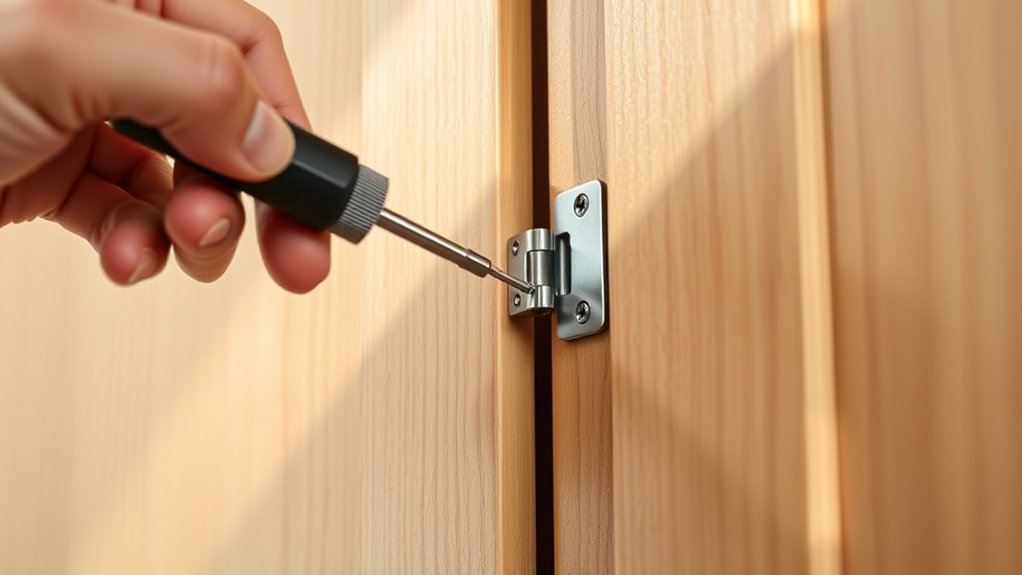
Although you might not notice it immediately, you’ll know kitchen cabinet hinges need adjusting when doors don’t close flush, appear misaligned, or rub against the frame. To identify hinge offset, start by visually inspecting the gap between the door and cabinet frame. Uneven spacing indicates a misalignment requiring correction.
Kitchen cabinet hinges need adjustment if doors don’t close flush, appear misaligned, or rub against the frame.
Next, gently close the door to observe if it catches or scrapes against adjacent surfaces, another sign the hinge setting is off. Check cabinet alignment by measuring from the door edges to fixed points on the cabinet face; inconsistent measurements confirm the need for adjustment.
Additionally, listen for resistance or unusual sounds when opening or closing doors, as these can signal hinge offset problems. By carefully assessing these factors, you can precisely determine which hinges require tweaking to restore proper function and appearance.
Identifying hinge offset and cabinet alignment issues early ensures smoother operation and prolongs cabinet lifespan.
Gather Tools to Adjust Kitchen Cabinet Hinges
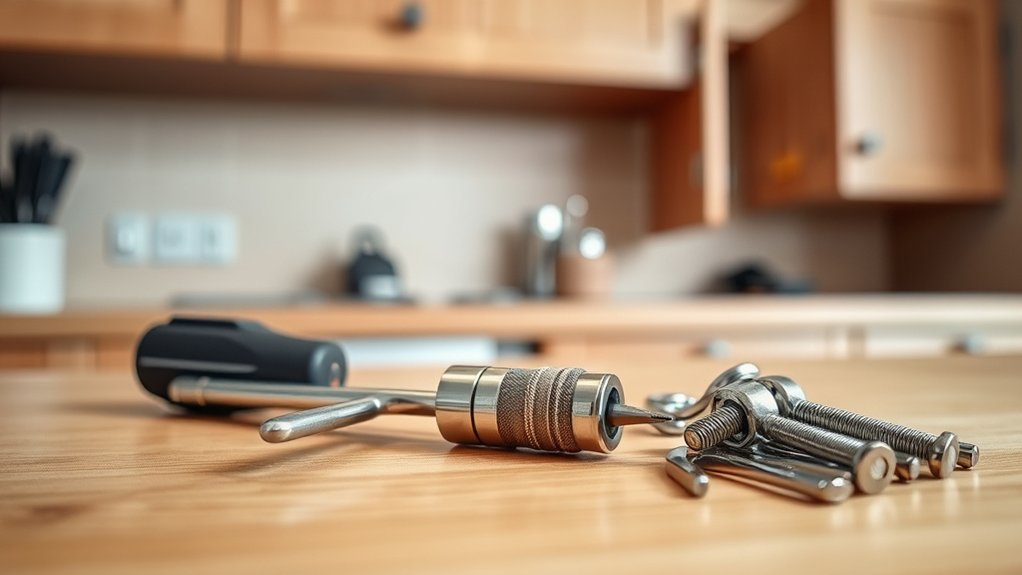
Before you start adjusting your kitchen cabinet hinges, gather the essential tools to ensure a smooth process. You’ll need a screwdriver that fits the hinge screws precisely to avoid stripping or damage.
Selecting the right size and type, usually a Phillips or flathead, is crucial for effective adjustment.
Essential Tools Checklist
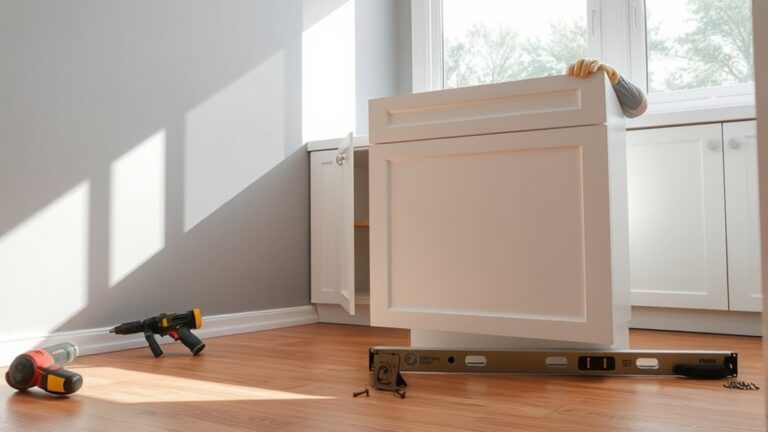
You’ll typically need a handful of essential tools to adjust kitchen cabinet hinges accurately and efficiently. Start with a reliable Phillips and flathead screwdriver to engage different screw types found on cabinet hinge sites.
A power drill with adjustable torque can speed up the process but use it cautiously to avoid stripping screws. A small level helps ensure doors sit perfectly aligned after you adjust hinge terminology such as depth, height, and side-to-side screws.
Needle-nose pliers assist in gripping tight components, while a ruler or measuring tape ensures precise spacing. Finally, keep a flashlight handy to illuminate hinge areas inside cabinets where visibility is limited.
Having these tools ready will streamline your adjustments and improve hinge performance without guesswork.
Choosing The Right Screwdriver
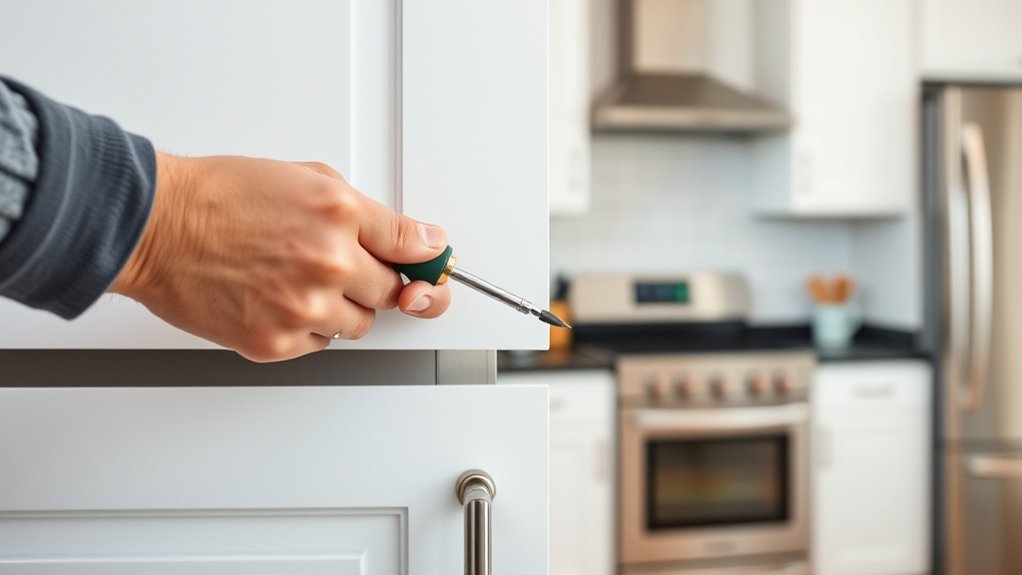
How do you guarantee a perfect fit when adjusting cabinet hinges? By choosing the right screwdriver. Selecting a screwdriver that matches the screw head type is crucial for precise adjustments.
Most kitchen cabinet hinges use Phillips or Pozidriv screws, so pick a screwdriver with a tip size that fits snugly to avoid stripping. When adjusting depth screws, accuracy is key; a mismatched screwdriver can slip, damaging the screw or hinge.
Opt for a screwdriver with a comfortable grip to maintain steady pressure during fine tuning. Additionally, consider the shaft length. Longer shafts offer better reach in tight cabinet corners.
How to Adjust the Depth of Kitchen Cabinet Hinges
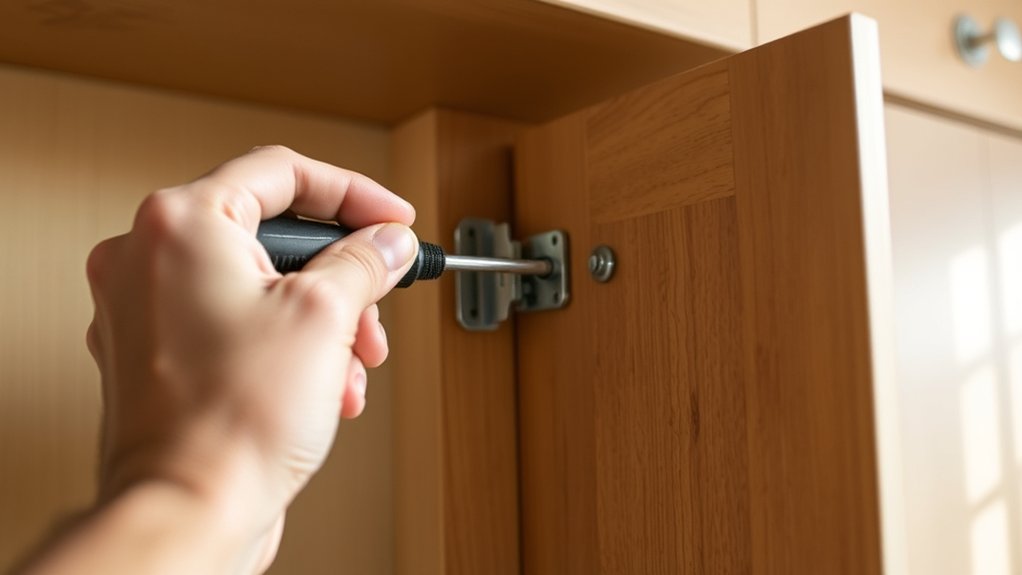
To adjust the depth of your kitchen cabinet hinges, first locate the depth adjustment screws, usually positioned on the hinge arm near the cabinet frame. Use a screwdriver to turn these screws slowly, moving the door closer or farther from the cabinet box.
Make small adjustments and check the door alignment frequently to ensure a proper fit.
Identifying Depth Adjustment Screws
Where exactly are the depth adjustment screws located on your kitchen cabinet hinges? Typically, these screws are found on the mounting plate attached to the cabinet frame or on the hinge arm itself.
To adjust depth, you’ll want to focus on the screws that control the horizontal positioning of the door relative to the cabinet face. These hinge screws often sit behind or near the main pivot point and may be recessed or covered by a plastic cap.
Identifying them requires examining the hinge closely; they usually differ from the screws used to secure the hinge to the door or cabinet. Once located, these depth adjustment screws let you fine-tune how far the door sits in or out, ensuring proper alignment and smooth operation.
Step-by-Step Depth Adjustment
When adjusting the depth of your kitchen cabinet hinges, start by loosening the depth adjustment screw just enough to allow the door to move forward or backward. Using a screwdriver, gently push or pull the door to the desired position, ensuring it aligns flush with the cabinet frame.
Once aligned, tighten the depth adjustment screw securely to lock the door in place. Perform small incremental adjustments for precision, checking door alignment after each change.
This step-by-step depth adjustment is crucial in your overall adjustments overview, ensuring smooth door operation and preventing wear. Regular hinge maintenance, including cleaning and lubricating moving parts, complements these adjustments to extend hinge life and functionality.
Following this method guarantees a professional, lasting fit for your kitchen cabinet doors.
Fix Cabinet Doors That Hang Too High or Low
How can you quickly correct cabinet doors that hang too high or too low? Start by loosening the screws on the hinge plates attached to the cabinet frame. This allows you to shift the door vertically.
Carefully move the door up or down to achieve the desired alignment, ensuring the cabinet door gaps remain even and consistent. Once aligned, tighten the screws securely to fix the hinge position.
If your hinges have an adjustable mounting plate, use the vertical adjustment screws to fine-tune the door height without removing the hinge. Always check that the door swings smoothly and closes flush with adjacent doors or the cabinet frame.
Avoid overtightening screws, which may strip the holes or misalign the hinge. By adjusting hinge alignment precisely, you maintain uniform cabinet door gaps, improve functionality, and enhance the cabinet’s aesthetic.
Remember to test each door after adjustment and make incremental changes for optimal results.
Align Cabinet Doors Side to Side
After adjusting the vertical position of your cabinet doors, the next step is to align them side to side for a uniform appearance. Aligning doors side to side ensures a clean, professional look and prevents gaps between doors. Here’s how you do it:
- Locate the horizontal adjustment screw on the hinge. This screw controls the door’s lateral movement.
- Turn the screw slowly clockwise or counterclockwise to shift the door left or right. Make small adjustments and observe the door’s position relative to the adjacent door.
- Continue fine-tuning until the gap between doors is even, and the edges align perfectly.
How to Adjust Hinges on Different Types of Kitchen Cabinets
Which hinge adjustment method suits your kitchen cabinets depends largely on the hinge type installed. For European-style concealed hinges, you’ll find three adjustment screws: side-to-side, height, and depth. Turn these screws to finely tune the door’s alignment relative to the cabinet mounting surface.
With overlay hinges, focus on the side-to-side and height screws, as depth adjustment might not be available. When working with traditional butt hinges, you’ll need to loosen the screws on the cabinet mounting plate or door, reposition manually, then retighten.
Always consider the hinge material. Metal hinges like stainless steel offer precise screw threading for micro-adjustments, whereas plastic components might limit fine tuning. For inset cabinets, depth adjustments are critical to ensure doors sit flush within the frame.
Adjust carefully to maintain consistent gaps and smooth operation. Remember, adjusting hinges on different cabinet types requires understanding their specific mounting and screw mechanisms to achieve optimal door alignment.
Fixing Common Cabinet Hinge Problems
When cabinet hinges start to malfunction, you’ll need to identify the root cause before making adjustments or replacements. Proper adjustment timing is essential to avoid worsening the issue or damaging hinge materials. Here’s how to fix common problems precisely:
- Loose Hinges: Check screws first. Tighten them with a screwdriver, but avoid overtightening, which can strip wood or damage hinge materials. If screws spin freely, replace them with longer or wall anchors.
- Misaligned Doors: Adjust the hinge screws to realign doors horizontally and vertically. Most modern hinges have multiple adjustment screws; turn them incrementally, noting the door’s movement.
- Squeaky or Stiff Hinges: Lubricate metal hinge parts with a silicone spray or light machine oil to restore smooth operation. Avoid heavy greases that attract dust.
How to Maintain Kitchen Cabinet Hinges
Regularly maintaining your kitchen cabinet hinges guarantees smooth operation and extends their lifespan. Start with cleaning hinges using a soft cloth and mild detergent to remove grease and dirt buildup. Avoid harsh chemicals that could corrode metal parts. After cleaning, inspect screws and tighten if necessary to prevent misalignment.
Soft close adjustment is essential to ensure doors close quietly and securely. Use the adjustment screws to fine-tune the tension and alignment, preventing slamming or slow closing. Lubricate moving parts with silicone spray to reduce friction and wear.
| Task | Tool Needed | Frequency |
|---|---|---|
| Cleaning hinges | Soft cloth, detergent | Monthly |
| Tightening screws | Screwdriver | Quarterly |
| Soft close adjustment | Screwdriver | Bi-annually |
Frequently Asked Questions
Can I Replace Kitchen Cabinet Hinges Without Removing the Doors?
You can replace hinges without door removal if the cabinet design allows easy access to screws. However, door removal often provides better control and precision, making hinge replacement more straightforward.
It also helps prevent damage during adjustment or installation.
What Types of Cabinet Hinges Work Best for Heavy Doors?
When you wrestle with heavy doors, choose full-overlay, soft-close hinges. They cradle weight like a gentle giant. These durable, precision-engineered hinges ensure smooth, quiet operation, matching your soft close preference while preventing sagging or misalignment over time.
Are Soft-Close Hinges Better for Kitchen Cabinets?
Yes, soft-close hinges improve kitchen cabinet functionality by reducing noise and wear, providing soft close benefits. Their enhanced hinge durability extends cabinet life, making them a practical, efficient upgrade for daily use and long-term performance.
How Do I Prevent Cabinet Hinges From Squeaking?
Did you know 70% of squeaky cabinet issues stem from poor hinge lubrication? To prevent squeaks, regularly apply lubricant to hinges and ensure door alignment is precise, reducing friction and wear for smooth, quiet operation.
Can Hinge Adjustments Fix Cabinet Doors That Stick Shut?
Yes, hinge adjustment can fix door sticking by realigning the cabinet door. Loosen screws slightly, move the door until it clears the frame, then retighten. This precise adjustment guarantees smooth opening and closing without obstruction.