Are Heat Pump Hot Water Heaters Better
If you’re weighing options for water heating, heat pump hot water heaters offer notable efficiency gains by moving heat instead of generating it, achieving coefficients of performance between 2.0 and 3.5. This means you can cut electricity use by up to 60%, potentially saving around $300 annually.
However, their effectiveness depends on climate and installation factors, raising questions about where they truly outperform traditional systems and what costs you might face upfront.
Key Takeaways
- Heat pump water heaters use ambient heat, offering 50–60% energy savings compared to traditional electric resistance models.
- They perform best in moderate to warm climates with adequate ventilation and space requirements.
- Higher upfront and installation costs are typically offset by energy savings within 2–4 years.
- Maintenance like regular filter cleaning and tank flushing is essential for efficiency and longevity.
- Noise levels and electrical system upgrades may be necessary considerations for installation and placement.
Heat Pump vs Traditional Water Heaters: Which Is Better?
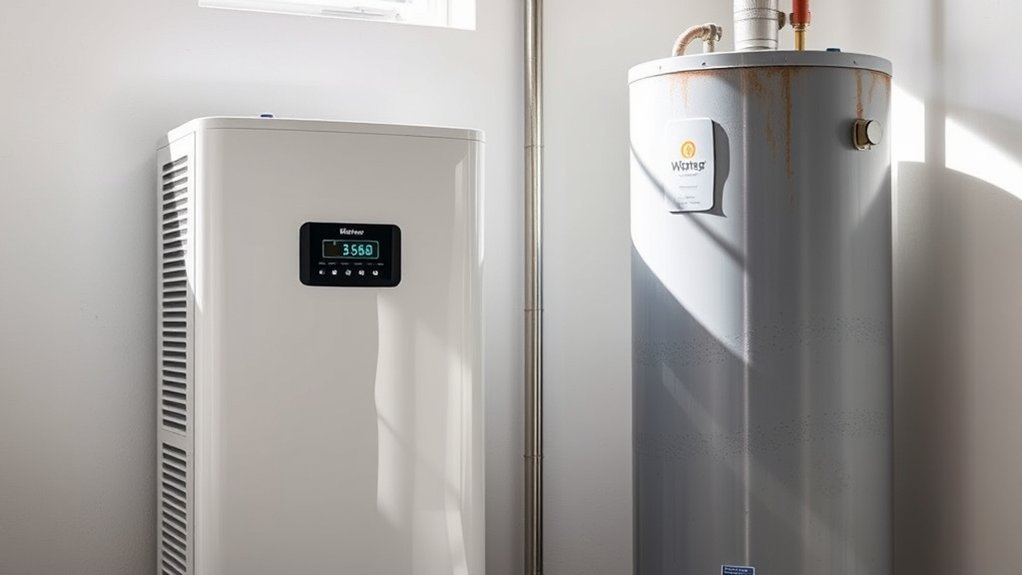
When comparing heat pump hot water heaters to traditional models, you’ll find that heat pumps use electricity more efficiently by transferring heat rather than generating it directly. This results in energy savings of up to 60% compared to conventional electric resistance heaters.
You should also consider couple compatibility, which refers to how well the heat pump integrates with your home’s existing plumbing and electrical systems. This is critical for optimal performance.
Warranty coverage varies; heat pumps often come with longer warranties (up to 10 years) than traditional units, reflecting their advanced technology and durability. While upfront costs for heat pumps are higher, their efficiency and robust warranty coverage can offset long-term expenses.
Which Homes Are Best Suited for Heat Pump Water Heaters?
Where do heat pump water heaters perform best? They excel in homes located in moderate to warm climates, where ambient temperatures consistently stay between 40°F and 90°F.
Heat pump water heaters thrive in moderate to warm climates with temperatures from 40°F to 90°F.
These units require sufficient surrounding air volume, typically a minimum of 1,000 cubic feet, to operate efficiently, as indicated in product packaging specifications. You’ll want to install them in spaces like basements, garages, or laundry rooms with adequate ventilation.
Homes with limited space or very cold environments may experience increased warranty claims due to compressor strain. Additionally, if your household has high hot water demand peaks, consider sizing carefully to avoid performance drops.
Reviewing product packaging for installation guidelines and understanding warranty claim conditions helps ensure optimal suitability and long-term reliability for your heat pump water heater.
How Do Heat Pump Water Heaters Save Energy?
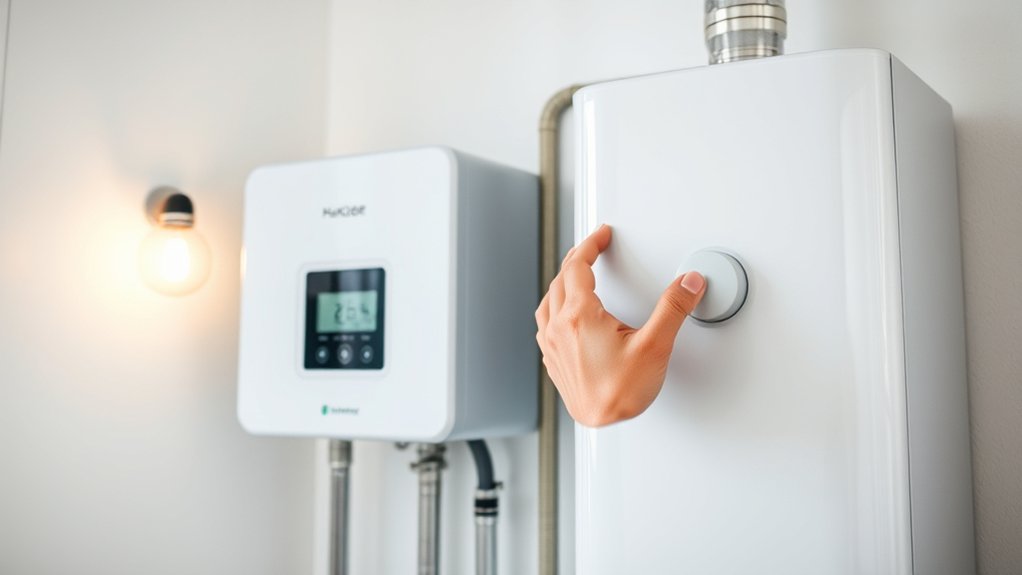
Selecting the right location and climate for a heat pump water heater sets the stage for its energy-saving potential. These units extract ambient heat rather than generating it directly, which reduces electricity use by 50-60%.
To address common energy myths, consider how heat pumps operate efficiently in warm, well-ventilated spaces. Here are some discussion ideas to help you understand their mechanics:
| Factor | Impact on Energy Savings |
|---|---|
| Ambient Temperature | Higher temps improve efficiency |
| Heat Transfer Method | Uses ambient heat, not resistance |
| Installation Location | Affects heat absorption |
| Insulation Quality | Minimizes heat loss |
| Compressor Efficiency | Determines overall energy use |
How Much Can You Really Save on Your Utility Bills?
You can expect a heat pump water heater to use about 50% less energy than a conventional electric model, substantially cutting your monthly utility bills. Over time, these savings accumulate, often offsetting the higher upfront cost within 2 to 4 years.
Let’s analyze how these efficiency gains translate into real-world cost reductions.
Energy Efficiency Comparison
Switching to a heat pump hot water heater can substantially lower your utility bills. Heat pumps use ambient air to heat water, achieving efficiencies 2–3 times greater than conventional electric resistance heaters.
Energy policy increasingly favors these systems due to their lower carbon footprint and compatibility with solar integration, maximizing renewable energy use. Here’s a concise comparison of energy factors:
| Feature | Heat Pump Heater | Electric Resistance Heater |
|---|---|---|
| Coefficient of Performance (COP) | 2.5 – 3.0 | 1.0 |
| Annual Energy Use (kWh) | 1,500 – 2,000 | 4,500 – 5,500 |
| Energy Cost per Year ($) | 180 – 240 | 540 – 660 |
| Solar Integration | Highly compatible | Less compatible |
Switching can cut your water heating energy use by up to 70%, markedly lowering bills and supporting clean energy goals.
Cost Savings Over Time
Lower energy consumption directly translates to significant cost savings over time. By switching to a heat pump hot water heater, you can reduce your water heating energy use by 50-60% compared to conventional electric models.
This efficiency gain can cut your utility bills by roughly $300 annually, depending on local energy rates and usage patterns. When evaluating cost savings, consider emerging micro trends in energy pricing and consumption behaviors that influence long-term expenses.
Additionally, niche festivals focused on sustainability often highlight these heaters’ ROI, proving their financial appeal beyond upfront costs. Over a typical 10-15 year lifespan, these savings can offset the higher initial investment, providing you with a net positive return.
Monitoring your utility bills post-installation confirms the real-world impact of this technology on your budget.
Installation Costs and Requirements for Heat Pump Water Heaters
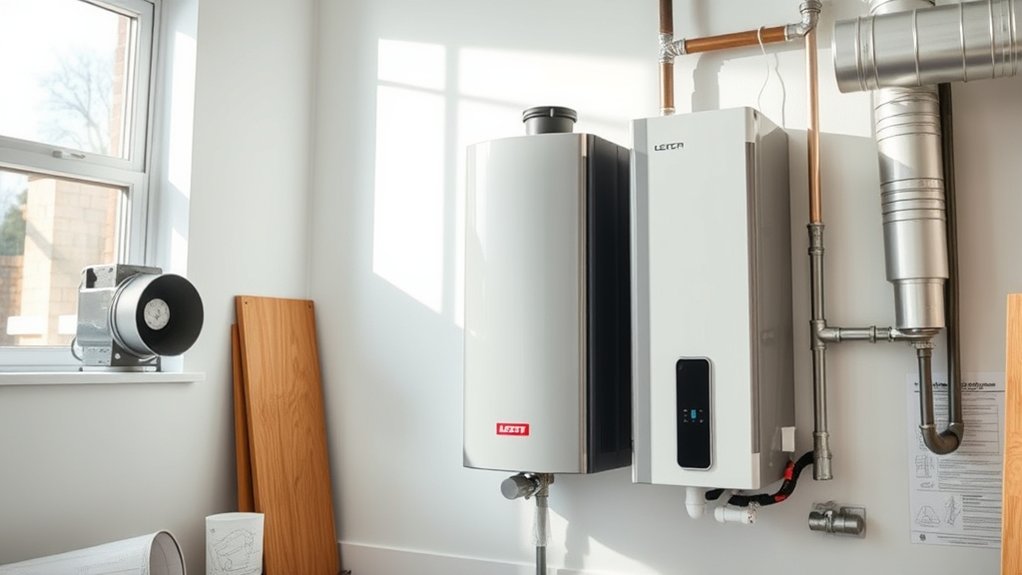
What factors influence the installation costs and requirements for heat pump water heaters? Primarily, space and existing infrastructure dictate complexity. Heat pump units require adequate room for air circulation, given their reliance on ambient heat energy with lower energy density than traditional electric heaters.
This means you might need to modify your installation site, impacting labor and material costs. Noise levels also play a role; these units generate more sound due to the compressor and fan, so placement must consider proximity to living spaces, potentially requiring soundproofing solutions.
Additionally, electrical system upgrades might be necessary to support higher power demands. On average, installation costs range from $1,200 to $3,500, varying by location and complexity. Proper planning ensures optimal performance and compliance with local codes.
Common Drawbacks of Heat Pump Water Heaters
You’ll face higher upfront costs with heat pump water heaters compared to traditional models, often 2-3 times more expensive. They also require specific space conditions, like adequate ventilation and room size, which can limit installation options.
Understanding these constraints helps you weigh the trade-offs before committing.
Higher Initial Costs
How much more will you pay upfront for a heat pump water heater compared to a conventional model? Typically, heat pump water heaters cost between $1,200 and $3,500, whereas conventional electric water heaters range from $400 to $1,000.
This price difference stems from advanced technology and components in heat pumps, leading to higher initial investment. While some may argue that maintenance costs or unrelated concepts like energy tariffs affect total expenses, these are irrelevant topics when focusing solely on upfront costs.
The higher initial cost can be a barrier despite long-term energy savings. Understanding this financial aspect helps you make an informed decision without confusing it with unrelated concepts such as installation location or electrical upgrades, which belong to other considerations.
Space and Installation Constraints
Beyond the higher upfront cost, heat pump water heaters demand specific space and installation conditions that may limit their suitability. You’ll face space constraints since these units require at least 1,000 cubic feet of air volume for optimal operation.
Installation challenges include the need for adequate ventilation and clearance around the unit to prevent overheating and maintain efficiency.
| Factor | Requirement/Impact |
|---|---|
| Minimum Air Volume | ~1,000 cubic feet |
| Clearance Needed | 1-3 feet around unit |
| Ventilation | Essential for heat exchange |
| Noise Level | 50-60 dB, may affect placement |
| Installation Cost | 10-30% higher due to complexity |
You must evaluate your available space carefully to avoid costly retrofits or operational inefficiencies.
How Long Do Heat Pump Water Heaters Last Compared to Traditional Models?
Wondering about the lifespan differences between heat pump water heaters and traditional models? Heat pump water heaters typically last 10 to 15 years, comparable to conventional electric models but slightly shorter than gas models, which can reach 15 to 20 years.
Heat pump water heaters last 10-15 years, similar to electric models but shorter than gas heaters.
Their long term reliability hinges on advanced components like compressors, which can fail earlier, contributing to upfront depreciation in overall value. However, the energy savings and lower operating costs often offset this initial depreciation.
Traditional models, with simpler technology, tend to have fewer mechanical issues affecting longevity. When considering replacement cycles, you should weigh upfront depreciation against potential energy cost reductions, as heat pump units may require more frequent component replacements but offer superior efficiency.
This balance is crucial for assessing total lifecycle value.
What Maintenance Does a Heat Pump Water Heater Need?
Regular maintenance is essential to keep your heat pump water heater operating efficiently and to extend its lifespan. Following manufacturer-recommended maintenance schedules and service intervals ensures optimal performance and prevents costly repairs.
Key tasks include cleaning the air filter, inspecting the anode rod, and flushing the tank to remove sediment buildup.
| Maintenance Task | Recommended Service Interval |
|---|---|
| Clean air filter | Every 3 months |
| Inspect anode rod | Annually |
| Flush tank | Annually |
| Check refrigerant level | Every 1-2 years |
Adhering to these maintenance schedules will help you maintain energy efficiency and system reliability. Neglecting service intervals often leads to reduced efficiency and potential premature failure.
How Does a Heat Pump Hot Water Heater Work?
Maintaining your heat pump water heater ensures it runs efficiently, but understanding how it operates can help you optimize its use. The system extracts ambient heat from the surrounding air using a refrigerant cycle, similar to an air conditioner working in reverse.
Proper maintenance and understanding your heat pump water heater improves efficiency and optimizes performance by utilizing ambient air heat.
A compressor increases refrigerant pressure, raising its temperature before transferring heat to your water tank through a heat exchanger. This process typically uses 50% less electricity than traditional electric heaters.
Avoid mixing unrelated science or irrelevant humor when considering performance metrics. The device’s efficiency, measured as a coefficient of performance (COP), usually ranges between 2.0 and 3.5, meaning it delivers 2 to 3.5 units of heat per unit of electricity consumed.
Understanding this cycle helps you appreciate why heat pump water heaters excel at energy savings and sustainability.
Is a Heat Pump Hot Water Heater Right for Your Home?
How well a heat pump hot water heater fits your home depends on factors like climate, space, and energy costs. If you live in a moderate to warm climate, your system will operate more efficiently, delivering up to three times the energy savings compared to traditional water heaters.
You’ll need adequate installation space, typically a basement or garage with at least 1,000 cubic feet of air volume, to ensure proper airflow. Consider your local electricity rates; higher costs may offset savings. Avoid distractions from unrelated topics or off topic ideas when evaluating your options.
If your priorities include reducing energy consumption and long-term savings, a heat pump heater is a strong candidate. However, if space or climate constraints exist, exploring alternatives may be more practical for your home.
Frequently Asked Questions
Can Heat Pump Water Heaters Work in Extremely Cold Climates?
Yes, heat pump water heaters can work in cold climates but their efficiency drops as temperatures fall. You’ll use more electricity compared to moderate climates, so comparing energy use helps optimize performance and costs.
Are Heat Pump Water Heaters Noisy During Operation?
Heat pump water heaters aren’t excessively noisy during operation; typical sound levels range from 45 to 60 decibels. You can minimize noise by choosing optimal installation placement, like a utility room away from living spaces.
Do Heat Pump Water Heaters Require Special Electrical Outlets?
You’ll need to ensure outlet compatibility and proper electrical grounding for heat pump water heaters. They often require dedicated 240-volt circuits with grounded outlets to handle their power demands safely and meet code requirements.
Can Heat Pump Water Heaters Be Used With Solar Power Systems?
Yes, you can integrate heat pump water heaters with solar power systems. This use case maximizes efficiency gains by utilizing renewable energy, reducing grid dependence, and lowering operating costs.
It is especially effective when paired with battery storage for off-peak operation.
Are There Any Government Rebates for Installing Heat Pump Water Heaters?
You can qualify for rebate eligibility on heat pump water heaters through various government programs. Check specific program timelines carefully, as they vary by region and may impact your installation schedule and financial benefits.
Conclusion
Choosing a heat pump hot water heater is like opening a hidden vault of energy savings. You’ll cut electricity use by 50–60%, saving around $300 annually, especially in moderate climates. Though upfront costs are higher, your investment pays off in 2–4 years through efficiency and reliability.
With proper installation and ventilation, you get long-term performance that traditional heaters can’t match. In short, heat pumps deliver smarter, data-backed savings for your home.
When considering your options, heat pump hot water heaters are a superior choice for both cost-effectiveness and environmental impact.